October 12-13, 2026, Berlin
ReBound Conference on Research Culture: From Perspectives to Action
Around 80 researchers and stakeholders from Berlin, across Germany and internationally gathered at the Humboldt Graduate School on 12-13 October 2026 for the ReBound conference to foster dialogue and build a shared understanding of research culture.
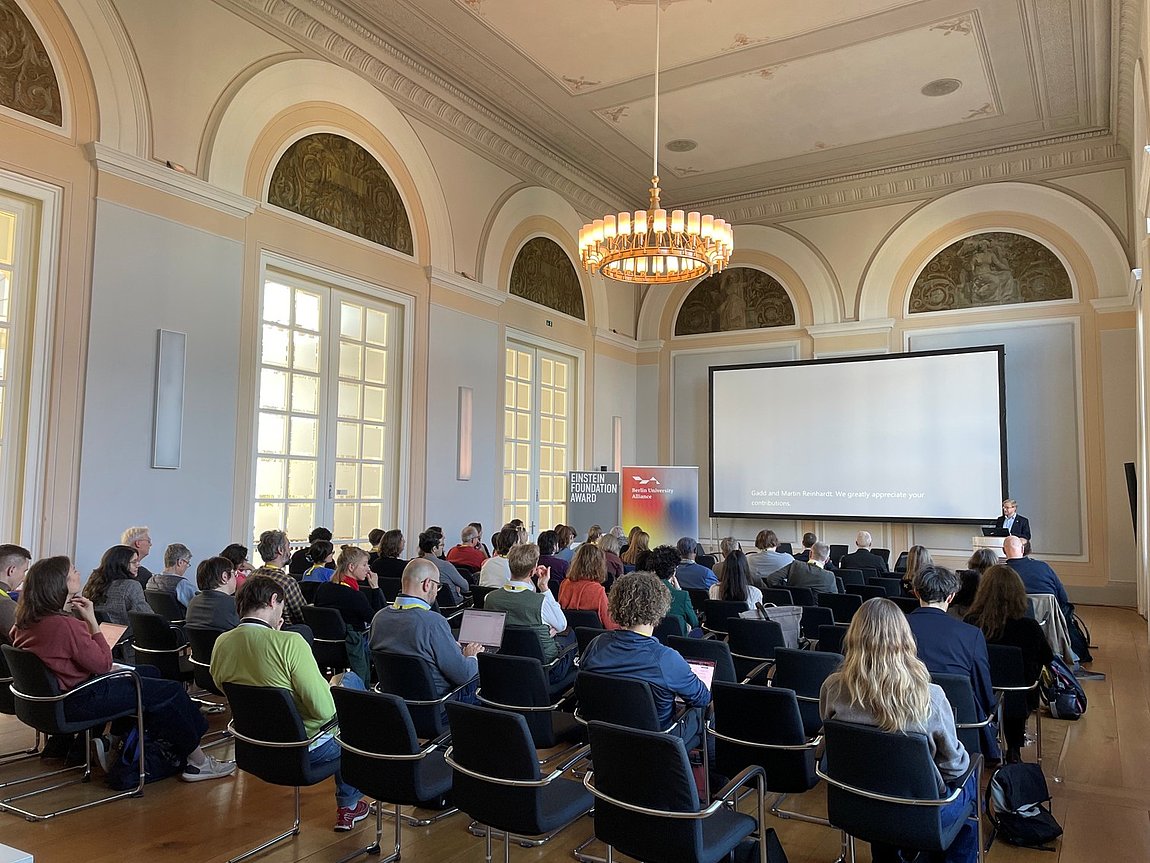
Martin Mann, Managing Director of the Berlin University Alliance, welcomed participants to a programme exploring how research culture is shaped by researchers, policy and institutions.
THREE PERSPECTIVES ON RESEARCH CULTURE
The lightning talks brought these perspectives into focus. Jens Ambrasat (Robert K. Merton Center for Science Studies) presented findings from the Berlin Science Survey, which captures the views of around 2,500 Berlin-based researchers on research practices, including the quality-assurance measures they use.
Steven Hill (Digital Science) drew on his experience as Research England's Director of Research and Chair of the UK Research Excellence Framework (REF) to discuss how policy can support change. He distinguished between grassroots initiatives led by researchers – such as the Open Access Movement – and change encouraged from the top down. Funding mechanisms and research assessment, he argued, can help create conditions in which change can take root. This requires clarity about the values to preserve and the problems to address.
Steven Wooding (Head of Research on Research in the Research Strategy Office, University of Cambridge) explored the governance perspective, asking what institutions contribute to research culture. Institutions can support interdisciplinary collaboration, ease administrative burdens and balance individual needs with shared infrastructure and long-term responsibilities. They must also make room for new approaches while retaining expertise that may prove valuable in the future.
A FISHBOWL ON THE CHALLENGES AHEAD
Elizabeth Gadd (Research Manager and Chair of the INORMS Research Evaluation Group) moderated the fishbowl, which invited participants to reflect on what research culture means and how institutions might improve it. Participants called for a more precise, context-sensitive understanding of the term.
The discussion turned to the conditions shaping research careers and research practice. Participants highlighted administrative burdens, budget pressures and inequalities in how researchers are evaluated across countries and disciplines. They also called on institutions to gather stronger evidence about research culture so they can identify which interventions are effective. Participants questioned comparisons between early-career researchers in different countries, noting that publishing opportunities – including access to locally relevant journals – vary across contexts.
Team science emerged as a key theme. Participants discussed the need for clear shared goals, roles that reflect those goals, and leadership models that support collaboration. They also questioned assessment systems that focus on individuals rather than teams, as well as funding structures that can prescribe team roles and career paths. Other concerns included pressure on early-career researchers to be geographically mobile and the need for attractive role models, including through shared leadership.
FOUR WORKSHOP STREAMS
Participants continued the conversation in four workshops:
- Research Assessment, led by Elizabeth Gadd and Ludo Waltman (Scientific Director of the Centre for Science and Technology Studies CWTS and Professor of Quantitative Science Studies at Leiden University), examined how universities are assessed across international contexts and what assessment approaches could help build universities fit for the future.
- Scholarly Communication, led by Priya Silverstein (Assistant Researcher, University of Coimbra) and Meta Cramer (Senior Researcher, Robert K. Merton Center for Science Studies), explored how career stage, institutional setting, discipline and region shape publishing choices.
- Understanding Research Culture through Stories, led by Lara Abel (Researcher, University of Cambridge) and professional writers Patrick Morris, Vanessa Ackermann and Craig Baxter, used creative non-fiction to explore positive and negative research-culture experiences.
- Responsible Cooperation Cultures, led by Romain Faure (Coordinator, Berlin Center for Global Engagement) and Patrício Langa (Professor, Eduardo Mondlane University), considered how collaborations can respect diverse research cultures while fostering shared standards and mutual benefit.
ADDRESSING PAPER MILLS
On the second day, Anna Abalkina (Research Fellow, Freie Universität Berlin) examined paper mills and their consequences for the scientific record and research community. She noted that many current responses treat the symptoms rather than the underlying causes, that paper mills are difficult to stop as legal entities, and that researchers may struggle to distinguish them from legitimate services. The discussion highlighted the need for greater awareness and mandatory training.
EQUITABLE RESEARCH COOPERATION AND CONFERENCE CLOSE
Romain Faure (Berlin Center for Global Engagement) presented a paper on recommendations for a more equitable research cooperation culture. In the closing summary session, workshop leads shared their outcomes, and Martin Reinhardt (Director, Robert K. Merton Center for Science Studies) delivered the conference's closing remarks.
For more details on the program and speakers, click here.
Jointly organised with